
Manufacturing
TechParts Inc. Optimization System
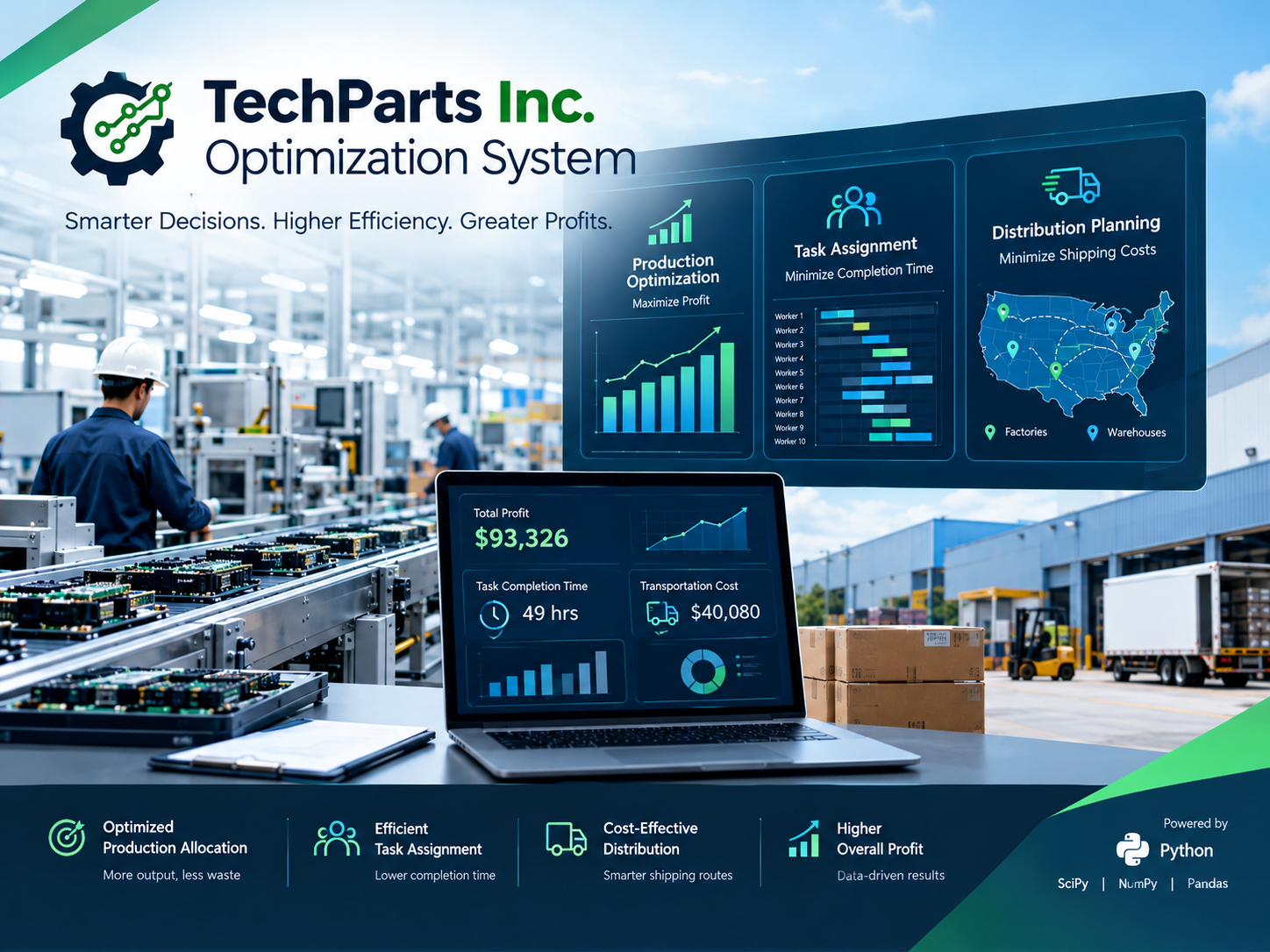
A data-driven optimization platform for electronics manufacturing that uses Linear Programming, the Hungarian Algorithm, and Vogel’s Approximation to optimize production allocation, worker-task assignments, and factory-to-warehouse distribution. The system reduces operational costs, improves resource utilization, and maximizes production profit.
The challenge
TechParts Inc. faced inefficiencies across production planning, workforce assignment, and distribution. Production resources were allocated without systematic optimization, worker-task assignments increased completion time, and ad-hoc factory-to-warehouse shipping resulted in unnecessary transportation costs. These inefficiencies reduced potential profits and increased operational expenses.
Context
The company operates 10 production facilities and 10 regional warehouses across the U.S. The optimization system was designed around simulated but realistic manufacturing, workforce, and logistics data to evaluate how Operations Research techniques could improve decision-making across the business.
The solution
We developed a data-driven optimization platform combining Linear Programming, the Hungarian Algorithm, and Transportation Optimization. The system determines profitable production quantities, assigns workers to tasks based on minimum completion time, and identifies cost-efficient factory-to-warehouse shipping allocations.
Design
The platform was designed as three interconnected optimization modules:
- Production Optimization: Maximize overall production profit while respecting resource and market constraints.
- Task Assignment: Assign 10 workers to 10 specialized tasks with minimum total completion time.
- Distribution Optimization: Minimize transportation costs while satisfying factory supply and warehouse demand.
Architecture
The system uses a Python-based computational architecture with NumPy, Pandas, and SciPy. Simulated datasets are processed by dedicated optimization modules, while SciPy's optimization solvers calculate optimal solutions. Matplotlib is used for data visualization and analysis.
Core techniques:
Linear Programming → Production
Hungarian Algorithm → Assignment
Vogel's Approximation + Linear Programming → Transportation
Development
The system was developed in Python with realistic datasets representing production margins, resource constraints, worker-task completion times, factory capacities, warehouse demands, and transportation costs. Each optimization problem was formulated mathematically and solved using established Operations Research techniques.
Results
The optimization system produced measurable improvements across all three areas:
- $93,326 maximum production profit
- 49 hours optimal total task completion time
- $40,080 minimum transportation cost
- $2,420–$7,920 estimated transportation savings per cycle
- Optimization modules solved in under 0.1 seconds
- Tested with matrices up to 50×50